Giseke Irrigation Project Set to Transform Agriculture in Gisagara
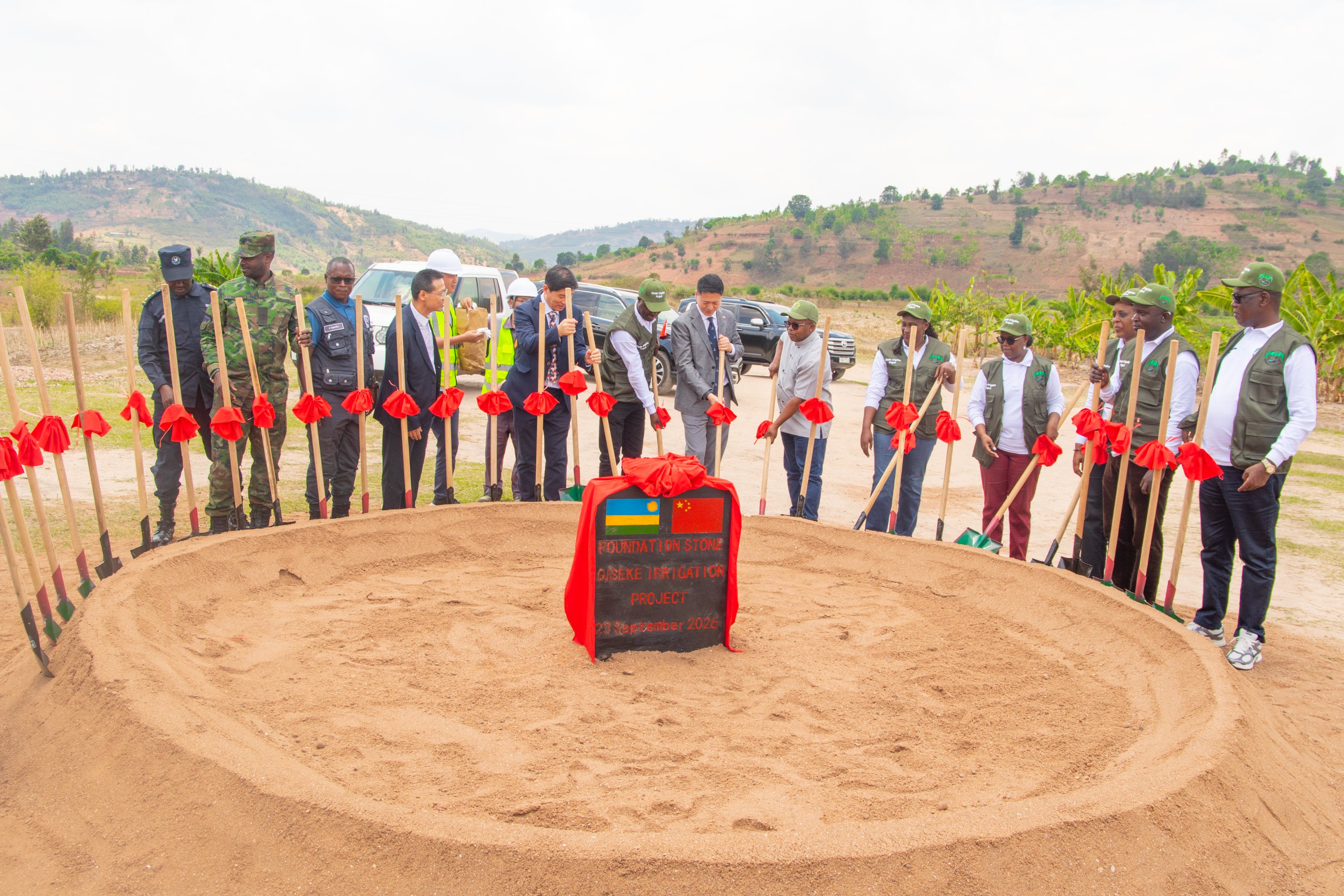
Gisagara District, 23 September 2026 — For farmers in Gisagara District, the arrival of reliable irrigation water could change more than the way crops are grown. It could change the predictability of harvests, household incomes and the way agriculture connects to markets.
This vision took a significant step forward on 23 September 2026 with the launch of the Giseke Agricultural Irrigation Project, a major investment aimed at supporting Rwanda’s transition towards a more modern, productive, climate-resilient and market-oriented agricultural sector.
With an estimated investment of US$47 million, the project will establish a 6.5 million cubic metre dam, a modern pressurized irrigation system covering approximately 2,670 hectares of net irrigated land, equivalent to about 3,000 hectares gross, as well as approximately 48.8 kilometres of lined canals.
For farmers who have traditionally depended heavily on rainfall, the infrastructure is expected to provide a more reliable source of water throughout the agricultural season. This will help reduce the risks associated with unpredictable rainfall while creating opportunities for farmers to increase productivity and strengthen food security.
But the project goes beyond irrigation infrastructure.
From farming with uncertainty to farming with opportunity
Reliable water can give farmers greater confidence in planning what, when and how much to produce. With improved irrigation, farmers can potentially increase production, diversify crops and move towards more predictable, commercially oriented agriculture.
The project is also expected to contribute to higher farmer incomes, employment creation, stronger agricultural value chains and improved access to markets.
This shift is particularly important as Rwanda seeks to transform agriculture from predominantly subsistence-oriented production into a more productive and market-driven sector.
A partnership behind the investment
The groundbreaking ceremony brought together representatives of the Government of Rwanda, the Government of the People’s Republic of China, development partners, local authorities, farmers and implementing partners.
H.E. Gao Wenqi, Ambassador of China to Rwanda, described the project as a tangible outcome of China–Rwanda practical cooperation and South-South cooperation, while highlighting its alignment with Rwanda’s agricultural modernization priorities.
The partnership reflects the growing importance of investment in agricultural infrastructure as Rwanda responds to challenges linked to climate variability, food security and the need to increase agricultural productivity.
Farmers at the centre
While the dam, irrigation network and canals will provide the physical foundation for the project, its long-term success will depend largely on how the infrastructure is managed and used.
The Minister called on farmers and cooperatives to actively participate in the management and sustainable use of the irrigation infrastructure. Farmers were encouraged to use water efficiently, protect the facilities and embrace modern, market-oriented farming practices.
For Gisagara’s farming communities, therefore, the Giseke project represents more than a new irrigation system. It offers an opportunity to build a more reliable agricultural production system—one where access to water can help farmers move from depending on the season to planning for the market.
As the project moves from groundbreaking to implementation, the expectation is that its impact will ultimately be measured not only in kilometres of canals or cubic metres of stored water, but in more productive farms, stronger value chains, better incomes and improved livelihoods for farming communities.